
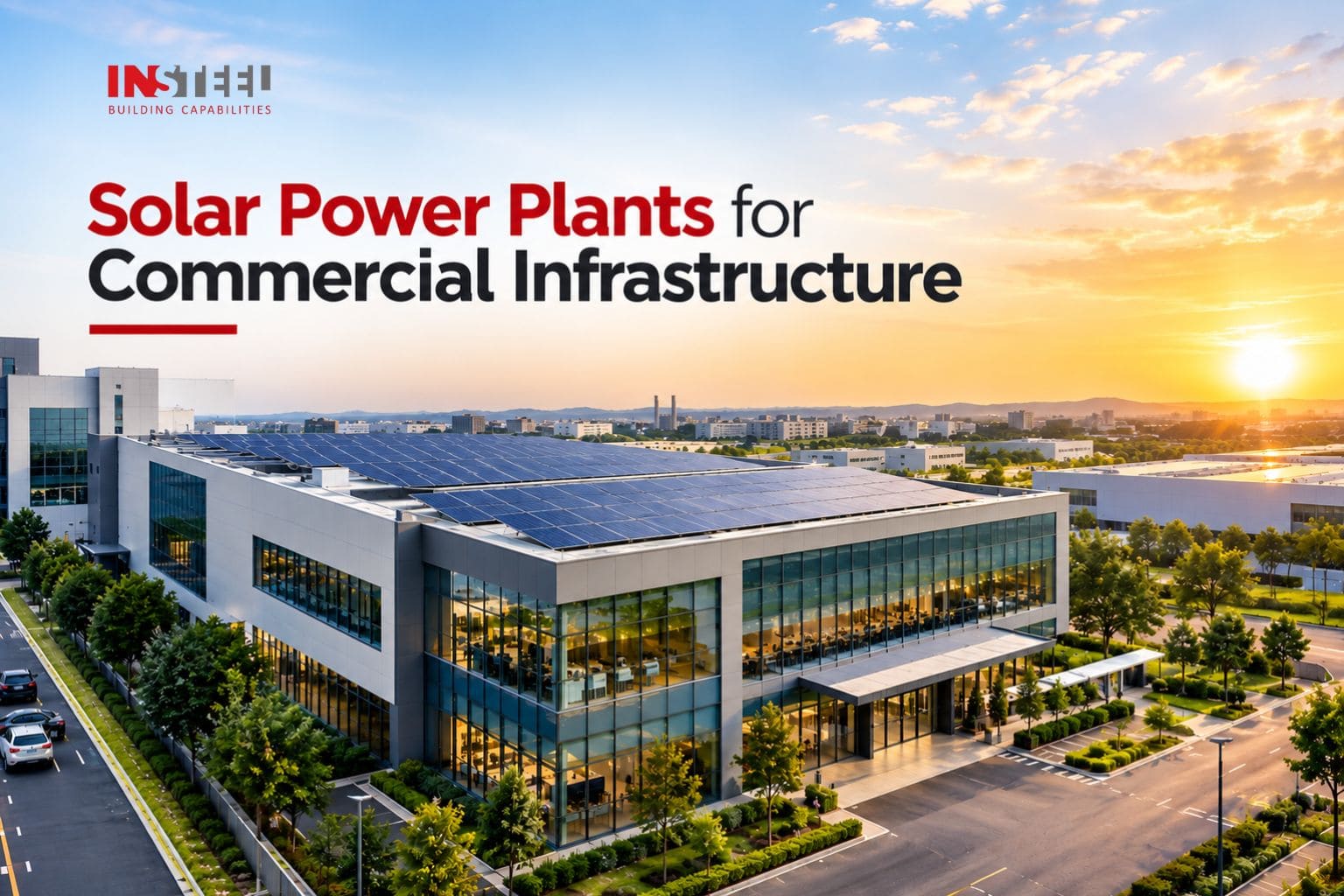
Most finance heads approving a commercial solar project ask the same question first: how fast does this pay for itself? It’s a fair question, but it’s also the wrong one to lead with. The businesses that get real value from solar aren’t the ones chasing the fastest payback number; they’re the ones treating the rooftop or open land they already own as an asset that’s been sitting idle for years, quietly costing them money every billing cycle.
A commercial solar power plant isn’t really an equipment purchase. It’s a decision to stop renting power from the grid at rising tariffs and start generating it yourself, on infrastructure you already control. In 2026, with commercial electricity tariffs in several states running between ₹8 and ₹12 per unit and solar generation costing a fraction of that once installed, the economics have moved from attractive to difficult to ignore.
What Counts as a Commercial Solar Power Plant
A commercial solar system sits in a different category from residential rooftop solar. Where home systems typically range from 3 to 10 kW, commercial installations generally start around 25 kW and scale up to several megawatts depending on the facility’s load profile. These are grid-connected systems built for continuous, heavy-duty operation, using three-phase inverters, higher-wattage bifacial modules, and mounting structures engineered to handle industrial-scale generation, not scaled-up versions of a home setup.
What most people don’t realise is that scale changes almost everything about how these projects are priced, engineered, and financed. A 100 kW system and a 1 MW plant aren’t just different sizes of the same product; they involve different structural considerations, different financing routes, and often entirely different rooftop or land assessments.
Understanding Commercial Solar Power Plant Costs in 2026
Cost is where most conversations about commercial solar either build confidence or lose it, depending on how transparently it’s explained.
As a rough benchmark, a 100 kW commercial solar system typically costs somewhere between ₹45 lakh and ₹60 lakh fully installed, depending on component quality, structural requirements, and site conditions. At 500 kW, that range moves to roughly ₹2 crore to ₹2.75 crore, a scale that suits larger manufacturing units, IT campuses, and hospitals with significant daytime energy consumption. Beyond 1 MW, projects are usually evaluated per MW, generally falling between ₹3.5 crore and ₹4.5 crore per MW for a quality, turnkey installation.
A few factors move these numbers more than people expect. Module technology matters, with newer TOPCon panels commanding a premium over standard PERC modules but delivering better long-term yield and slower degradation. Site conditions matter too. A straightforward flat industrial roof costs less to work with than a complex, ageing structure that needs reinforcement before it can safely carry a solar system. And in 2026 specifically, tightened domestic content requirements on modules and cells have pushed commercial project costs up compared to the year before, so a quote from twelve months ago is no longer a reliable reference point.
Here’s where things get interesting: the headline cost figure is only half the story. What actually determines whether a project makes financial sense is the payback period, and for commercial solar in India, that typically lands between three and four years, sometimes compressing further where tariffs run on the higher end.
Real Benefits Beyond the Electricity Bill
Direct Cost Reduction
The most obvious benefit is also the most immediate. Businesses installing commercial solar typically see electricity cost reductions of 50 to 70 per cent, depending on system size relative to consumption and how well the plant is designed against the facility’s actual load curve.
Depreciation and Tax Advantages
Commercial buyers don’t qualify for residential subsidy schemes. Still, accelerated depreciation benefits available to businesses meaningfully reduce the effective cost of a system over its early years, something that’s often left out of simplified cost conversations.
Protection Against Rising Tariffs
Grid tariffs for commercial and industrial consumers have moved in one direction for years, and there’s little reason to expect that trend to reverse. A commercial solar power plant fixes a large share of your energy cost at today’s generation economics, insulating your operating budget from future tariff hikes.
A Long-Term, Appreciating Infrastructure Asset
In our experience, the businesses that get the most value from solar stop thinking of it as an electricity bill fix and start treating it as infrastructure. A well-engineered plant, built on a structurally sound foundation, keeps generating reliable returns for 25 years or more, not just the payback window.
ESG and Sustainability Positioning
For businesses reporting against ESG frameworks or answering to institutional stakeholders, a self-generated renewable energy asset is no longer a nice-to-have. It’s increasingly part of how investors, clients, and regulators evaluate businesses.
Why Structural Engineering Is the Part Most Providers Skip
Here’s what rarely gets discussed in commercial solar conversations: the plant is only as reliable as the structure carrying it. Whether it’s a rooftop system on an ageing industrial shed, a carport spanning a parking facility, or a ground-mounted plant on open land, the engineering beneath the panels determines whether the plant still performs at full capacity in year twenty, not just year two.
Most commercial solar installation companies in India are strong on the electrical and generation side of the project. Fewer bring genuine structural engineering expertise to the table, the kind needed to assess load capacity, plan for wind resistance, and design systems that hold up under real industrial conditions over decades, not just pass an initial inspection.
This is precisely where Insteel’s background sets us apart. Before we were a solar installation company, we spent over two decades as structural steel engineers building infrastructure for demanding industrial environments. That discipline now shapes how we approach every commercial solar power plant we design, from rooftop and in-roof systems to solar carports and large ground-mounted installations across Maharashtra, Goa, and Karnataka.
Making the Decision
If your business is weighing a commercial solar power plant, the numbers alone won’t tell you everything you need to know. Site conditions, structural readiness, and the quality of the engineering behind the design matter as much as the per-kW price on a quote. A plant that’s cheaper upfront but poorly engineered for your specific roof or land will cost you more over its lifetime than one built right the first time.
If you’re exploring industrial solar panel installation in India for your facility, or evaluating options for a commercial solar system that’s built to perform well beyond its payback period, it’s worth starting with a proper site and structural assessment rather than a generic quote. Reach out to our team for a feasibility consultation tailored to your building and your energy goals.