
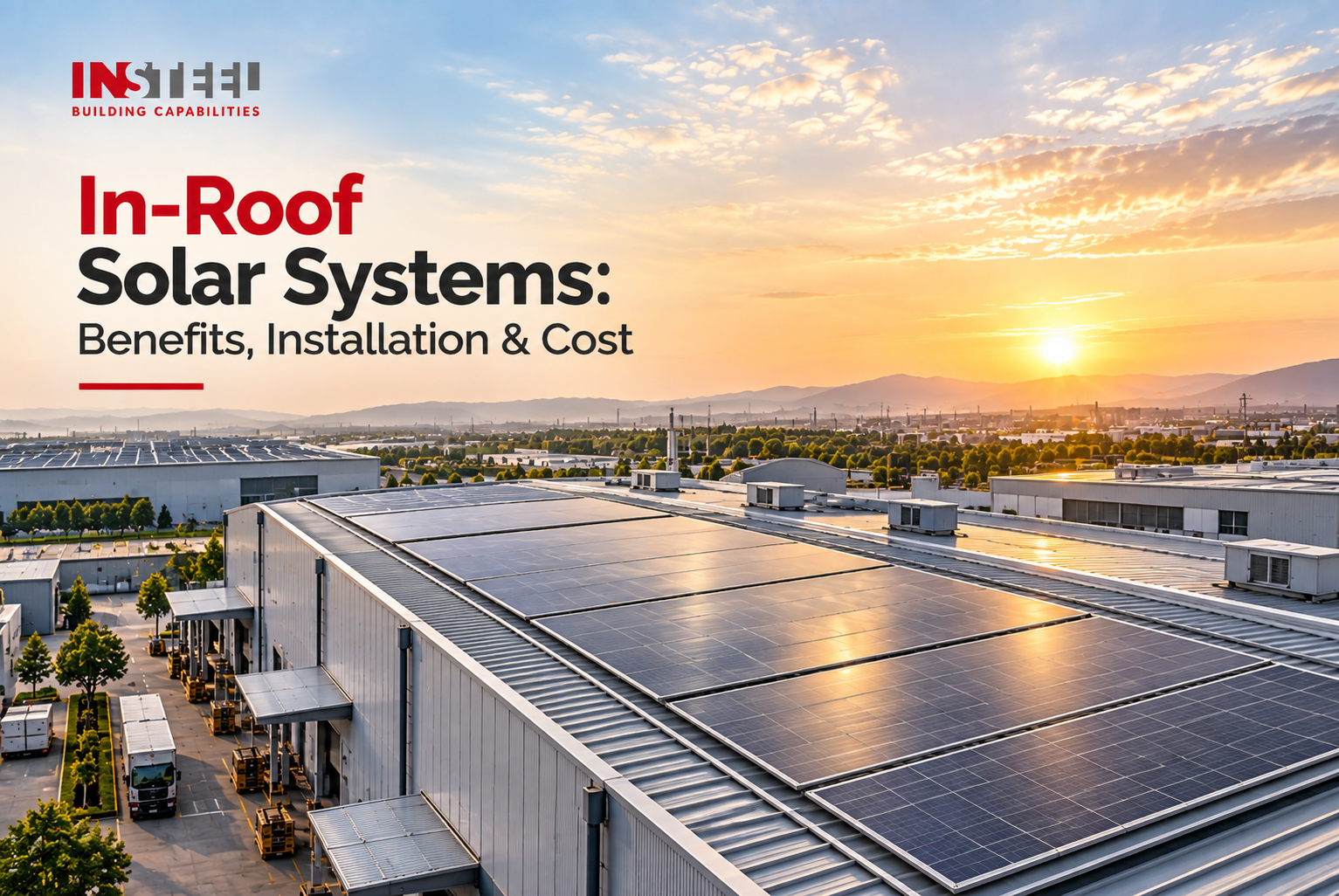
Every factory owner who has installed conventional rooftop solar knows the quiet dread that comes with monsoon season. Panels sit on top of the roof, but the roof itself is still ageing underneath them, and every fresh leak means climbing back up through a live solar array just to find the source. It is a strange trade-off. You solve one problem, high electricity bills, and inherit another, a roof that now needs to be maintained around the very system meant to protect it.
This is exactly the gap an integrated solar roof is built to close. Instead of adding solar on top of a roof, it replaces the roof altogether, making the building’s structure and power generation one system rather than two separate problems stacked on top of each other.
What Is an In-Roof Solar System, Really?
An in-roof solar system is not a solar panel installation in the traditional sense. It is a roofing system that generates electricity. Instead of metal sheets or tiles covering your shed or warehouse, solar modules themselves form the outer layer of the roof.
No separate roofing material sits beneath the panels, and no mounting structure bolts onto an existing sheet roof. The modules are engineered to carry the load, resist wind uplift, and keep water out, all while producing power. For industrial sheds, warehouses, and large commercial buildings across India, this single shift changes how the entire structure behaves over its lifetime.
What most people don’t realise is that this is as much a structural engineering decision as it is an energy one. Getting it right depends less on the panels themselves and more on how well the underlying structure has been designed to support them.
How It’s Different From Conventional Rooftop Solar
Conventional rooftop solar sits above your existing roof on a mounting frame. The roof stays as it is, and the solar system becomes an additional layer with its own penetrations, brackets, and cable runs.
An in-roof skips that step entirely. Here’s where things get interesting: because the panels are the roof, there is no second structure to maintain, no gap where debris and moisture collect, and no separate roof lifecycle to plan around. You are not managing a roof and a solar plant. You are managing one asset that does both jobs.
For older industrial sheds where the existing roof is already near the end of its life, this is often the more sensible route. Rather than reinforcing an ageing structure to carry an add-on solar system, you replace the roof with one engineered from day one to generate power.
Key Benefits of an Integrated Solar Roof
Leak Proof by Design
Roof leaks are almost always a story of compromised joints and penetrations. An integrated solar roof panel system is designed as a single, continuous waterproof layer, engineered with proper flashing, sealing, and drainage built into the structure rather than added around it afterwards.
Higher Structural Reliability
In our experience, the highest long-term cost in rooftop solar isn’t the panels; it’s structural failure caused by poor load planning. Because an in-roof system replaces the roofing sheets rather than sitting on them, load distribution, wind resistance, and material fatigue can all be engineered in from the start, not adjusted for after installation.
One Asset, Not Two
You eliminate the maintenance overlap between roof and solar system. No ageing roof underneath a newer solar array creates mismatched lifecycles. You replace, upgrade, and maintain everything as one unit.
Better Space and Aesthetic Efficiency
Because the panels form the roof surface itself, there’s no wasted gap between roofing material and modules. The result is a cleaner profile, useful for facilities where appearance matters as much as output, such as corporate campuses or institutional buildings.
Stronger ESG and Asset Value Positioning
An integrated solar roof reads differently on paper than a bolt-on solar system. It is infrastructure, not an accessory, which matters increasingly to businesses reporting against sustainability and ESG frameworks.
The Installation Process
Installing an integrated solar roof is a more involved process than a standard rooftop retrofit, and that is by design.
Feasibility and structural assessment. Before any design work begins, we study the existing structure, load capacity, and site conditions in depth. This step decides almost everything that follows.
Engineering and design. The roof and the solar system are designed together, not separately. Load paths, drainage, wind loading, and electrical layout are worked out as one integrated plan rather than a solar system retrofitted onto someone else’s roofing design.
Execution. Because the system replaces the roof, installation typically happens in coordination with the building’s operational schedule, particularly for live industrial facilities where downtime has to be minimised.
Commissioning and long-term maintenance. Once operational, the system is monitored for both energy performance and structural health, since the two are no longer separate concerns.
What Does an In-Roof Solar System Cost?
This is usually the first question, and the honest response is that it depends on more variables than most people expect: roof size, the building’s structural condition, module specifications, site accessibility, and whether the project concerns a full roof replacement or new construction.
What’s worth understanding upfront is that an integrated solar roof will generally cost more than a conventional rooftop system per kilowatt, largely because you are paying for roofing performance and power generation in a single system rather than layering solar onto an existing structure. It evens out over the system’s lifetime. You are not budgeting separately for roof repairs, leak fixes, and eventual reroofing on top of solar maintenance. For many commercial and industrial buildings, particularly those with roofs already nearing replacement, the payback period lands in a similar range to conventional solar, typically around three years, while avoiding a second capital expense down the line for roofing work.
Who Should Consider an Integrated Solar Roof?
This solution makes the most sense for facilities where the roof itself is a serious asset decision, not an afterthought. Industrial in-roof solar installation in India is particularly relevant for manufacturing units, warehouses, and pharmaceutical or logistics facilities where large roof spans, ageing sheet roofing, or frequent leak issues already exist.
Commercial in-roof solar installation in India suits corporate campuses, institutional buildings, and large retail or hospitality facilities where roof aesthetics, long-term durability, and sustainability reporting all carry weight in the decision.
In both cases, the underlying logic is the same. If a roof replacement is on the horizon anyway, pairing it with solar generation from the outset almost always makes more sense than treating the two as separate projects years apart.
Why Structural Expertise Matters More Than the Panels
Most solar providers in India understand energy generation well. Far fewer understand what it actually takes to hold a roof together under decades of load, weather, and wear. That gap is where most integrated solar roof projects run into trouble later, not because the panels underperform, but because the structure underneath wasn’t engineered to support them properly in the first place.
This is where a genuine InRoof solar installation company in India needs to bring more than electrical expertise to the table. It needs to bring structural engineering discipline, the kind that comes from decades of working with steel, roofing systems, and complex industrial builds, not just solar deployment experience.
At Insteel, that structural foundation starts every in-roof project. Two decades of structural steel engineering sit behind every integrated solar roof we design, which means load-bearing, waterproofing, and long-term durability are treated as first principles, not afterthoughts bolted on once the panels are decided.
If your facility’s roof is due for an upgrade, or if recurring leaks and rising power costs have you weighing your options, it’s worth looking at what an engineering-led integrated solar roof could do for your building’s next twenty-five years, not just its next monsoon. Contact our team for a feasibility assessment tailored to your site.