
Most facility managers evaluating solar don’t start by asking which technology is better. They start by asking whether their roof can handle another twenty years of monsoons, heat cycles, and maintenance crews walking across it. That question, more than any spec sheet, usually decides whether in-roof solar or conventional rooftop solar is the right call.
Both systems generate power from the same sunlight, and both sit on the same building. The difference is in how they relate to the roof itself, and that difference shapes everything from upfront cost to what happens when something eventually needs repair. Which is exactly why choosing the right In-Roof Solar Installation Company in India matters as much as choosing the system type for your commercial or industrial unit.
Two Different Relationships With the Roof
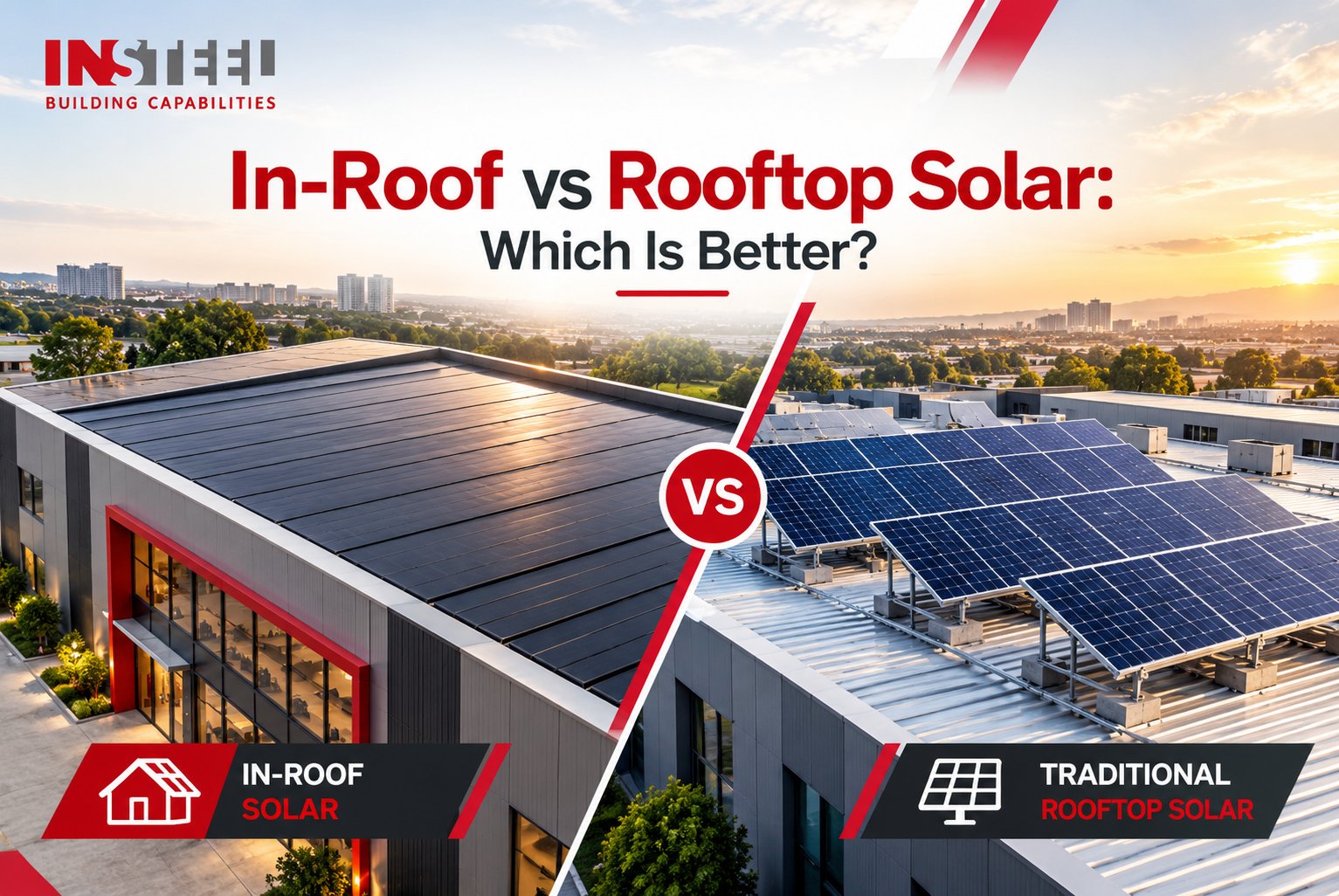
Conventional rooftop solar mounts panels above an existing roof using a racking structure. The roof stays exactly as it was, and the solar array becomes a second layer with its own brackets, cable runs, and penetration points. It’s a widely used approach precisely because it works with what’s already there, which makes it faster to install and generally cheaper per kilowatt.
An in-roof system takes a different position entirely. The solar modules replace the roofing sheets rather than sitting above them. There’s no separate roof underneath collecting moisture or ageing quietly out of sight; the modules themselves carry the structural and waterproofing load. You’re not choosing between a roof and a solar system anymore. You’re building one asset that does both jobs.
Neither approach is universally right. The better question is which relationship makes sense for your building, your budget, and your timeline.
Where Conventional Rooftop Solar Still Wins
For a large share of commercial and industrial buildings, rooftop solar remains the practical choice, and for good reason. If your existing roof is in decent structural condition and isn’t due for replacement anytime soon, mounting panels on top gets you generating power faster and at a lower initial spend. It’s also why many facilities weighing in roof solar for industrial buildings against a simpler retrofit often start here first. Retrofits on warehouses, offices, and manufacturing sheds with sound sheet roofing are usually straightforward: assess load, design the layout, install, and commission.
This is also the more forgiving way for buildings with irregular roof geometry or where only part of the roof needs solar coverage. You are not committing to a full roof replacement just to add generation capacity. And because the racking sits above the existing surface, maintenance access to the panels themselves tends to be simpler.
The trade-off is that you now have two systems ageing on the same structure at different rates. If the roof underneath develops a leak years down the line, finding and fixing it often means working around a live array, which is exactly the kind of maintenance headache that shows up in facility budgets more often than owners expect.
Where In-Roof Solar Makes More Sense
In-roof solar tends to justify its higher upfront cost in a specific set of situations, and industrial facilities run into these more often than most people assume. If your roof is already nearing the end of its usable life, replacing it with an in-roof system means you’re not paying for a new roof and a solar array as two separate line items spread across different years. You fold both decisions into one project.
Buildings with a history of leak issues are another strong case. Because in-roof systems are engineered as a single continuous waterproof layer, without the joints and mounting penetrations that come with racked panels, they remove one of the most common sources of long-term maintenance cost.
There is also a structural debate that gets neglected. Every solar installation adds load to a roof, whether it replaces the surface or sits on top of it. With in-roof systems, that load, along with wind uplift and thermal movement, gets calculated into the primary structural design from day one rather than retrofitted around an existing frame. For large-span industrial rooftops which are supposed to carry decades of expected service life, that difference in how the load is engineered matters more than it looks on paper.
Commercial buildings where structural formation and sustainability reporting carry weight—corporate campuses, institutional buildings, and hospitality properties—often lean toward in-roof for a different reason. A flush, integrated solar roof reads as infrastructure rather than an add-on, which tends to matter for ESG disclosures and how a building presents to visitors or tenants.
Comparing the Numbers That Actually Matter
Cost per kilowatt almost always convinces one to prefer conventional rooftop solar, since you are not paying for roofing performance and power generation in a single engineered system. But that comparison only tells you the beneficial side of a roof replacement that is already on the horizon.
In that case, running the numbers on rooftop solar plus a future reroofing cost, against an in-roof system priced once, usually narrows the gap considerably, sometimes reversing it.
Payback period for both systems typically comes to a similar range, often around three years, once accelerated depreciation and power bill savings are accounted for. Where they diverge is over the following two decades. A conventional system carries the ongoing risk of roof-related repairs as a separate cost centre. An in-roof system, if engineered properly, treats that risk as designed out from the start.
How To Take A Call On What Is Profitable?
The honest answer to which system is better depends less on the technology and more on the condition and lifecycle stage of your roof. A structurally sound roof with years of life left generally makes conventional rooftop solar the more efficient choice. A roof that’s ageing, leak-prone, or due for replacement within the next few years usually tips the calculation toward in-roof.
What matters more than either technology, though, is the structural engineering behind it. A rooftop system poorly linked to actual load conditions creates the same long-term risk as an in-roof system designed without proper waterproofing detailing. This is where working with a genuine In-Roof Solar Installation Company in India, one that treats every project as a structural and lifecycle decision rather than a purely electrical one, changes the outcome more than the choice of system type itself.
At Insteel, that structural discipline comes from two decades of steel engineering applied directly to solar. Whether a facility needs in-roof solar for industrial buildings with large spans and ageing sheet roofs, or in-roof solar for commercial buildings where long-term asset value and appearance matter, the right answer starts with an honest assessment of the roof you already have, not the panel you want to buy. If you’re weighing the two for an upcoming project, that assessment is worth getting before the decision is made.